Last posts
- Carbon footprint 2025: local travel is increasing, but it isn’t replacing long-distance travel
- Santa Barbara Gives Up Nearly $3 Million a Year to Curb Short-Term Rentals: Why Home Exchange Isn’t Affected
- Cabot Trail in Fall: The 185-Mile Canadian Road Trip at Peak Color
- 93% of North American Travelers Are Looking at Trains: Why Rail Makes the Perfect Slow Trip
- Burlington, Vermont: The Perfect Fall Weekend on Lake Champlain, by Train or by Road
Our carbon footprint: why and how?
What is a carbon footprint?
At HomeExchange, we have been voluntarily carrying out our carbon footprint assessment since 2019, refining our calculation method year after year.
Coordinated by the Carbon Footprint Association and ADEME (French Agency for Ecological Transition), a carbon footprint assessment is a method for calculating a company's greenhouse gas emissions. Conducting a carbon footprint assessment allows companies to obtain an estimate of the largest carbon-related emissions and to develop an action plan for improvement.
Want to learn more about how a carbon footprint assessment works, and the methodology used by HomeExchange? Feel free to check our 2022 article which explains the method (and you can also find the results for 2023 and 2024 this way!)
A carbon footprint assessment carried out independently and then submitted for validation
After using external tools until 2021, we partnered with OuiAct, a French firm renowned for its expertise in climate strategy, to develop a measurement tool tailored to our specific needs. We can now independently conduct our carbon footprint assessment, while also submitting it to OuiAct for expert validation.
Key findings and lessons learned from our 2025 carbon footprint assessment
The scope of our results by emission
According to our estimates, HomeExchange was responsible for creating approximately 1,174,284 tonnes of CO2e, or an average of 628 kg CO2e per HomeExchange guest.
This represents a 36% increase compared to 2024 which is significant, but still lower than the growth in our number of trips (+42%).
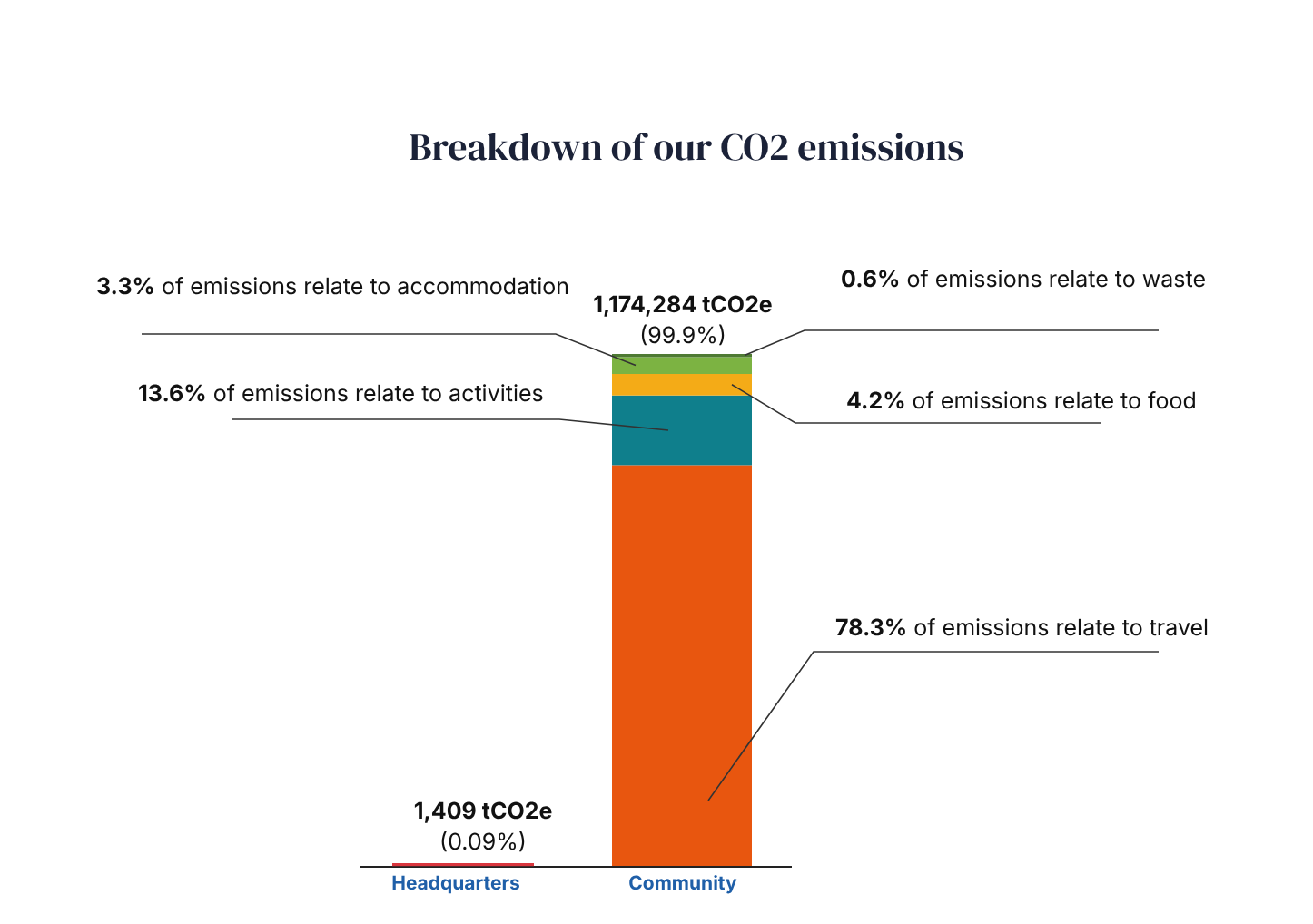
99.9% of our emissions come from trips within the HomeExchange community, which is normal, as our team of 150 employees is small compared to more than a million travelers! As in previous years, almost 80% of this impact was related to travel.
Community impact: growth in local tourism, but no decline in long-haul travel
As in previous years, the number of home exchanges carried out is increasing faster than the carbon emissions associated with these trips.
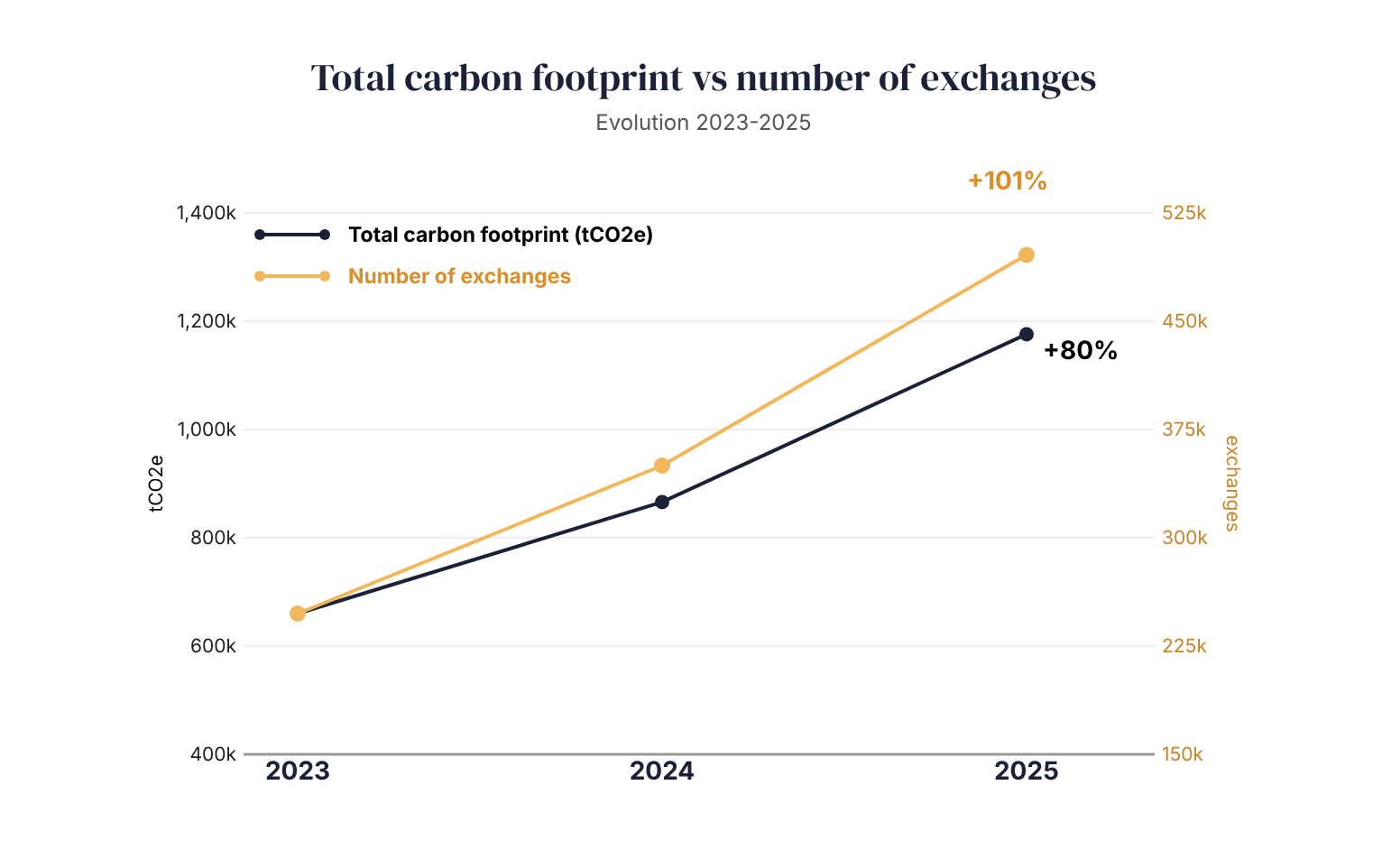
How can we explain that our CO2 emissions are increasing less rapidly than the number of exchanges carried out?
We know that long-haul journeys (over 3000 km) account for the largest impact.
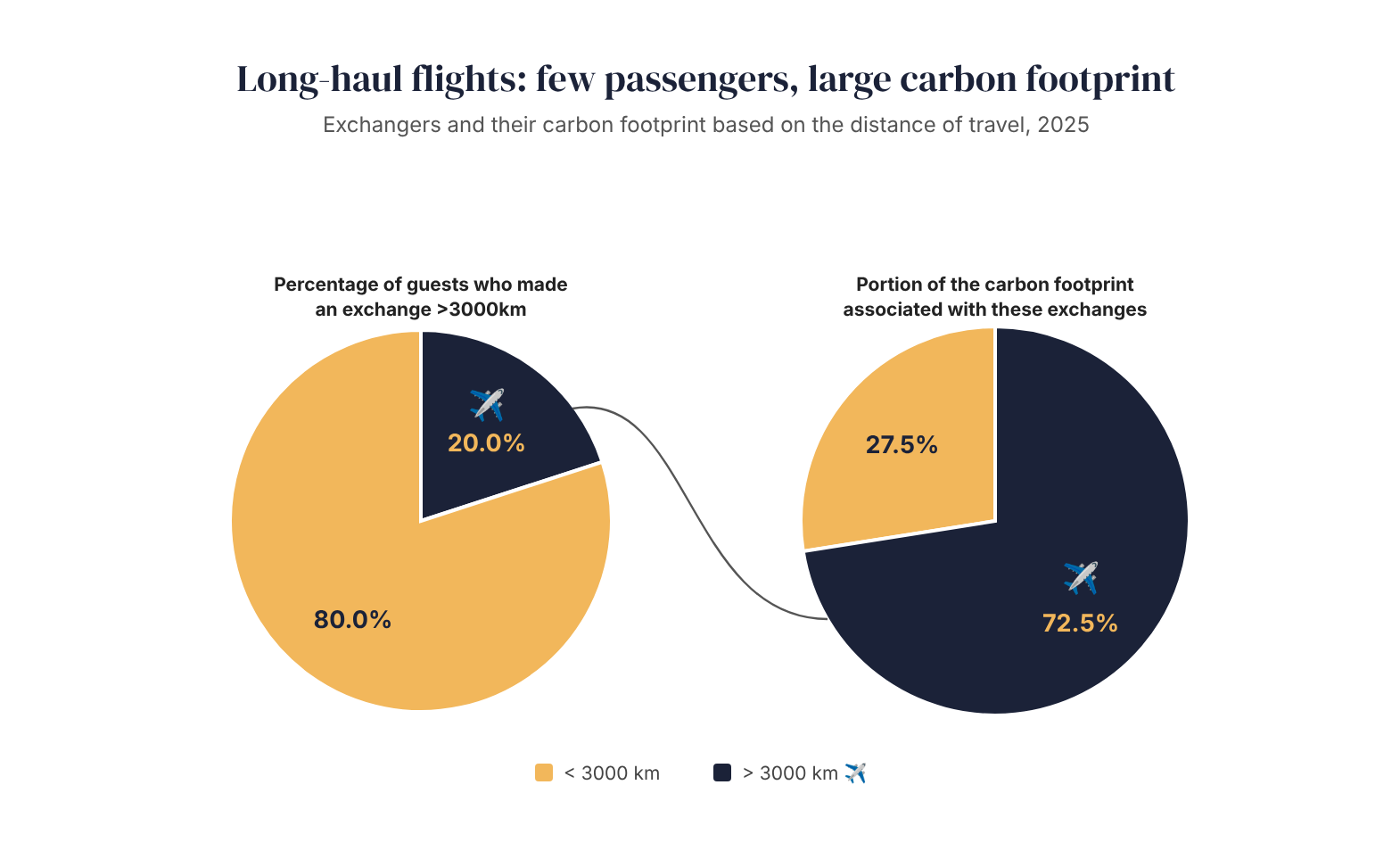
So we dug deeper to better understand the evolution of these particular journeys.
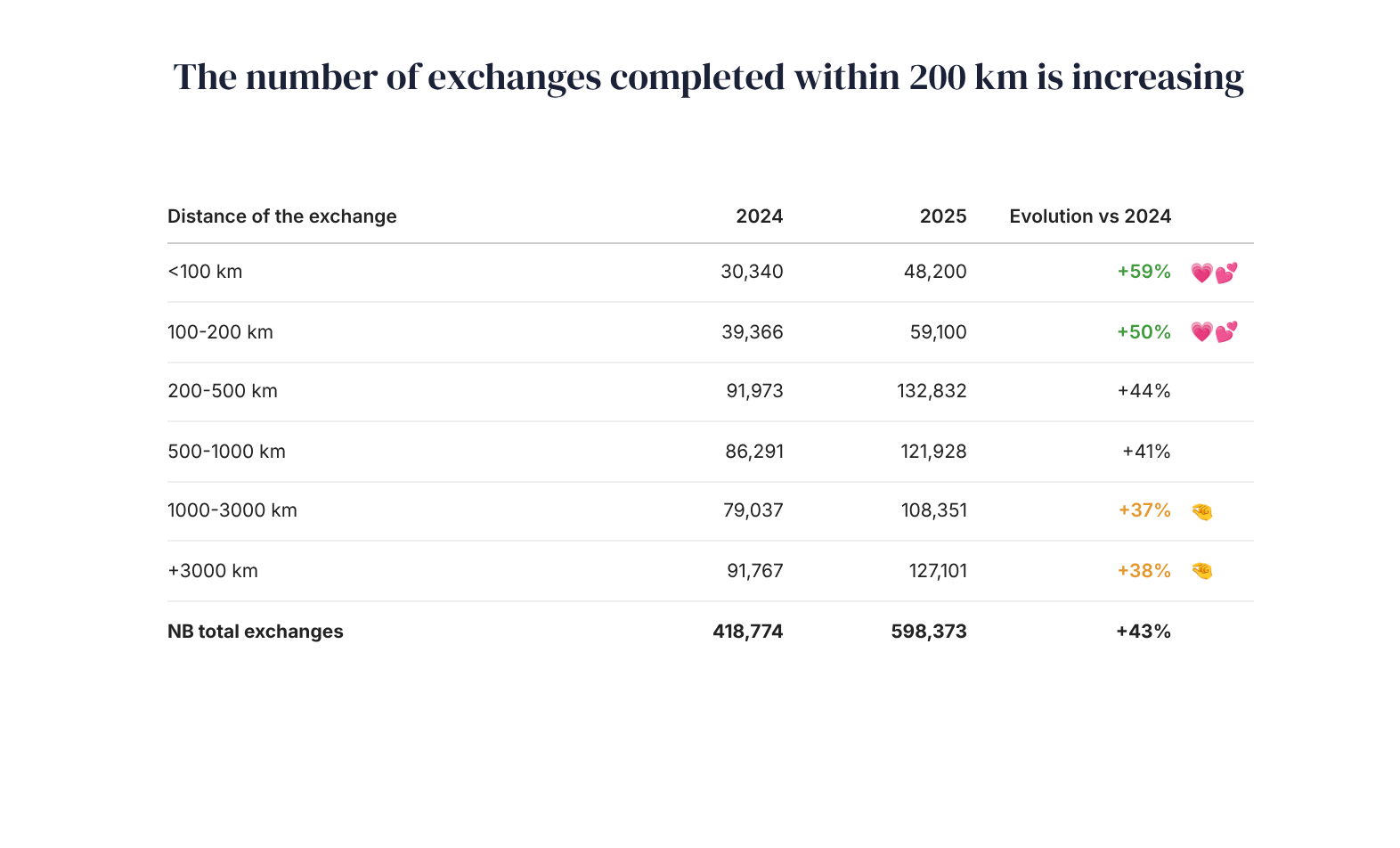
Looking at the evolution of the number of exchanges made by guests and according to distance, we realized that the number of long-haul trips has remained stable over time, while the number of local exchanges under 200km has increased sharply.
💡
Learning:
The apparent improvement in CO2 emissions per guest (-3% per guest compared to 2024) hides another reality: local tourism has developed, but without replacing long-distance travel.
The apparent improvement in CO2 emissions per guest (-3% per guest compared to 2024) hides another reality: local tourism has developed, but without replacing long-distance travel.
Do travel habits change with how long our members have been with us?
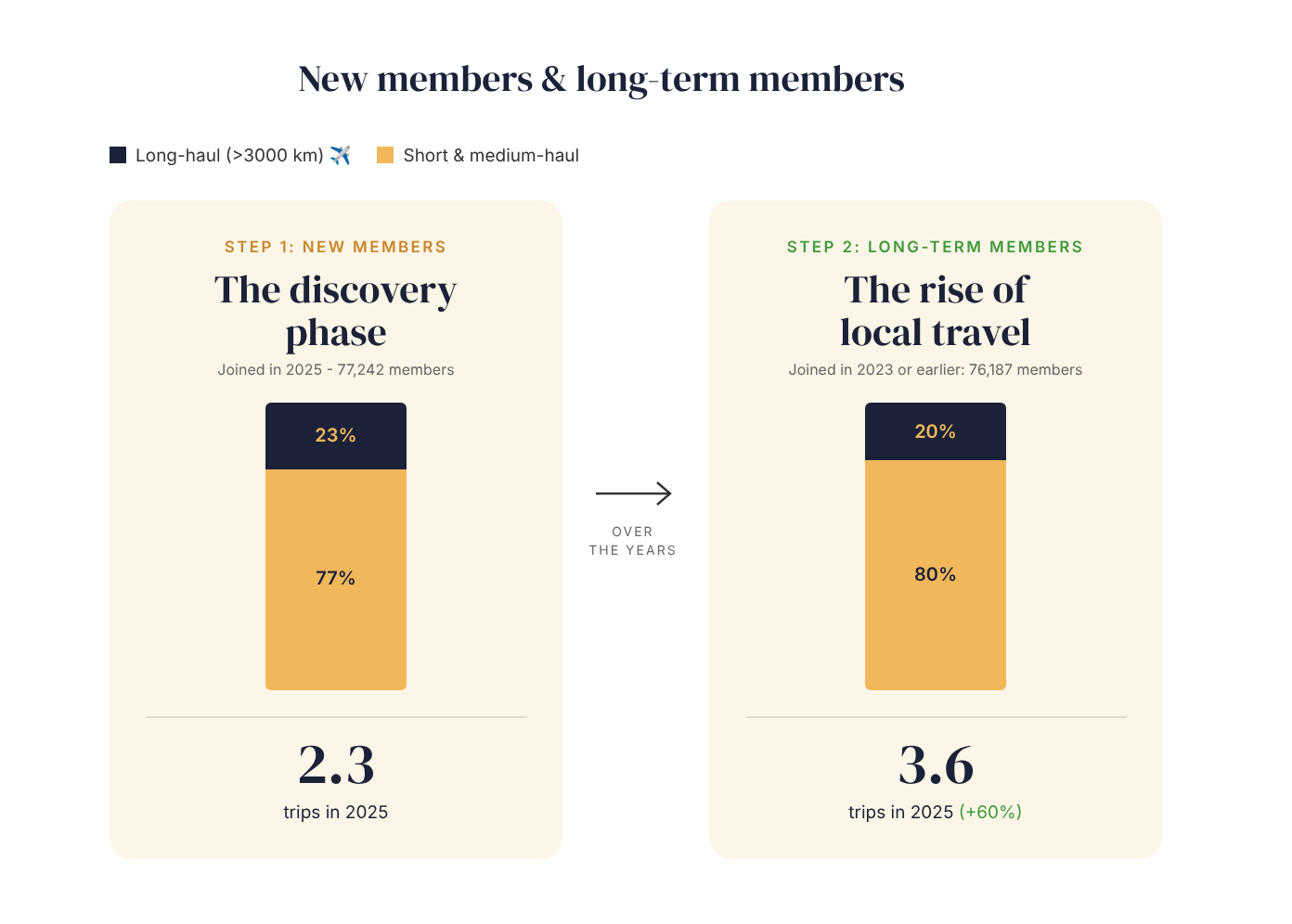
To go further, we questioned how practices have evolved over time: do long-term members of our community favor a more regular and local mode of travel, or on the contrary, does their impact intensify long-haul travel?
💡
Learning:
During their first year of discovery, new members make a higher proportion of long-distance trips (23% of their total). As the years go by and they become more familiar with the platform, they travel more often and increasingly favor local trips (80% of exchanges are short or medium-haul), without abandoning longer journeys, which remain stable in volume.
During their first year of discovery, new members make a higher proportion of long-distance trips (23% of their total). As the years go by and they become more familiar with the platform, they travel more often and increasingly favor local trips (80% of exchanges are short or medium-haul), without abandoning longer journeys, which remain stable in volume.
HQ emissions: a carbon footprint that is increasing due to the growth of our business and digital advertising
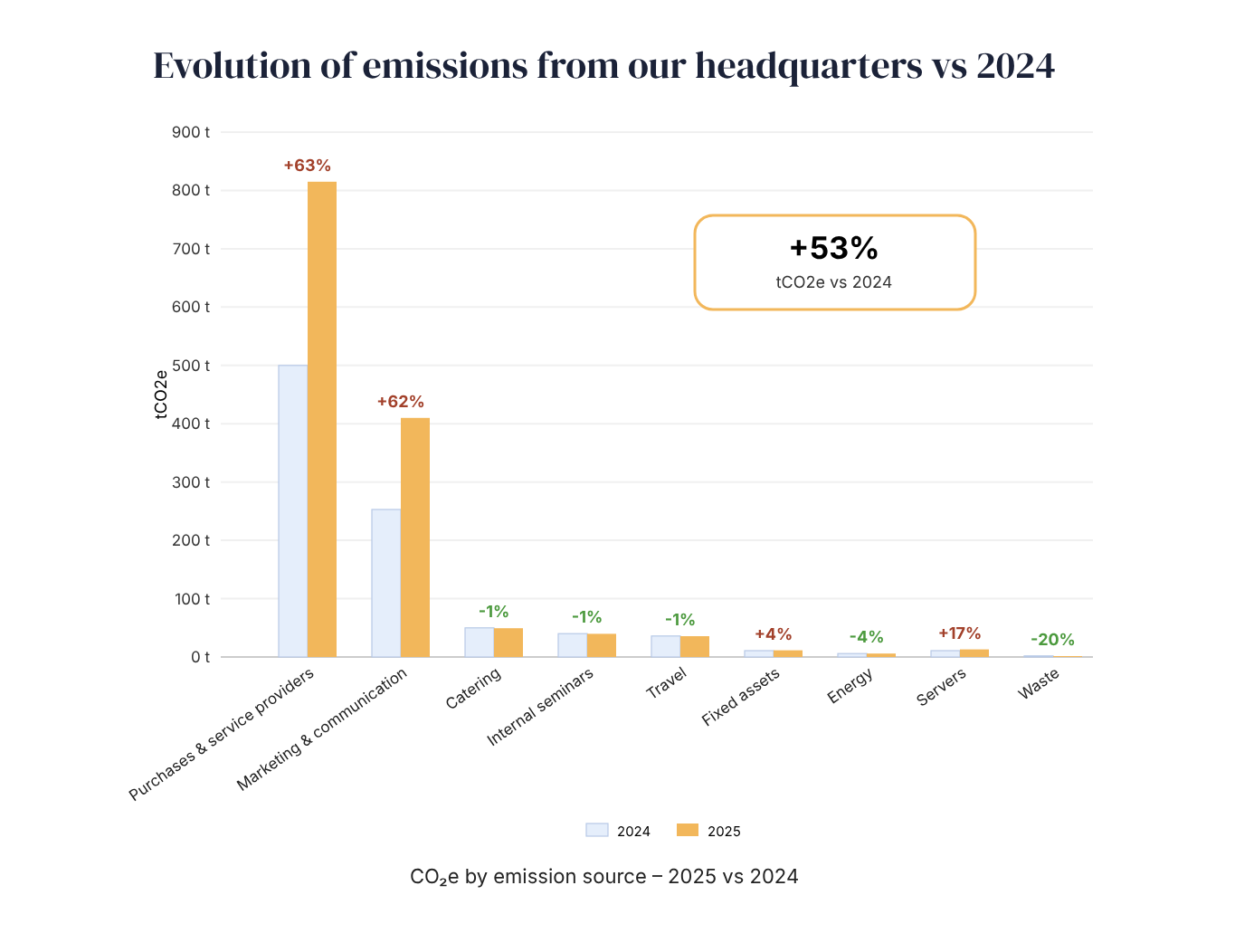
Our carbon footprint related to the activities of our headquarters amounts to 1409 tCO2e, an increase of 53% compared to 2024.
Key findings and lessons learned regarding emissions related to our headquarters
- This increase is primarily linked to the growth in purchasing and service provision, and digital advertising.
We will not dwell on the increase in purchases and services, which are difficult to avoid in a growth phase, and over which we have limited solutions.
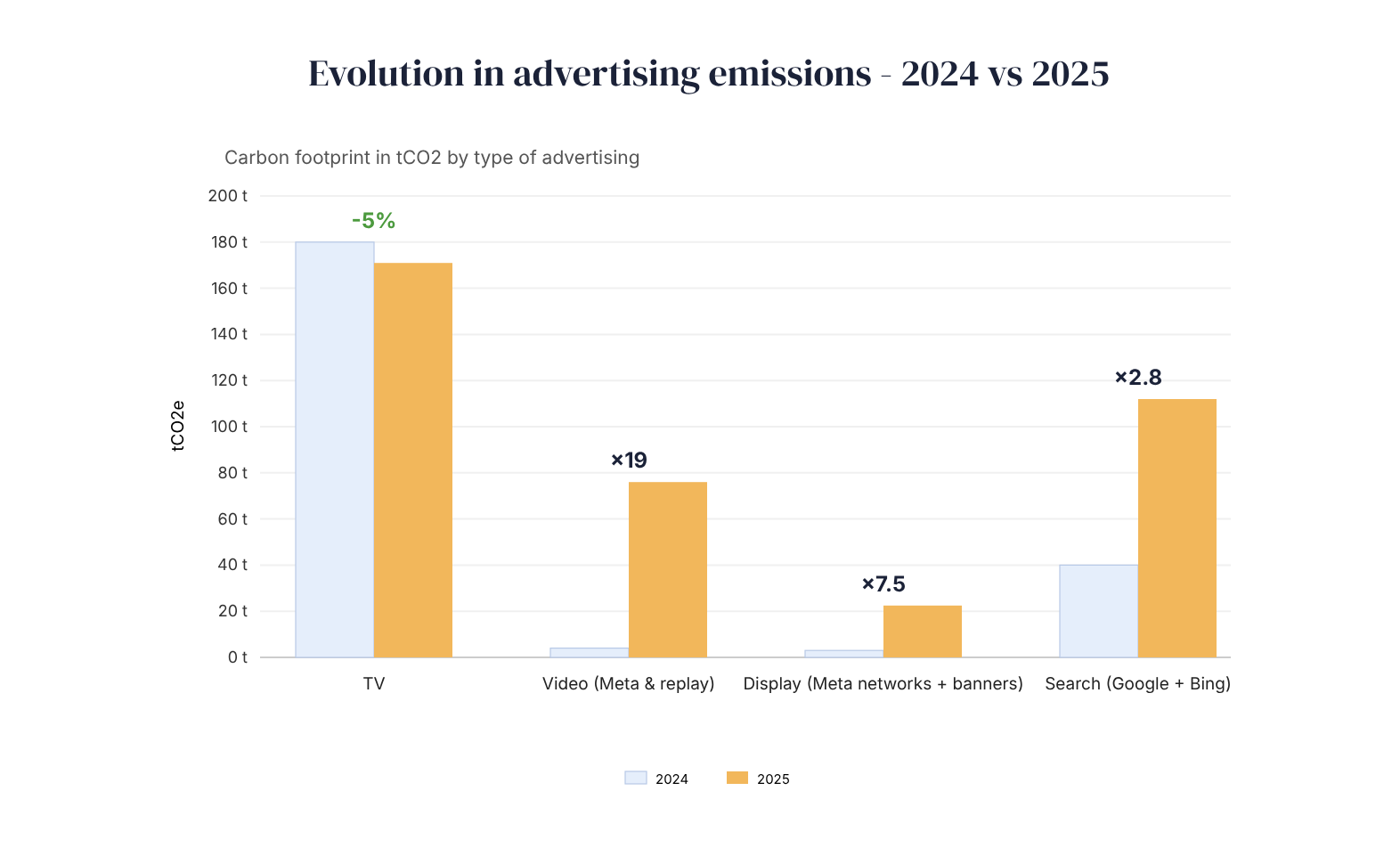
Regarding communication and marketing: television is HomeExchange's biggest source of advertising. However, the significant growth in online advertising is what explains the substantial increase reflected in 2025. This includes ads on Meta, Google, YouTube, and other platforms. We invested considerably more last year in display campaigns and video formats, which explains the rise in our digital advertising footprint.
- Focus on employee emissions
While the footprint of our headquarters has increased by 53% due to our acquisition investments, the footprint related to our employees shows real restraint: -1% compared to 2024. Despite the increase in the team (~150 employees), our internal emissions remain under control thanks to the extension of the lifespan of our equipment, the transport policy favoring soft mobility, and eco-friendly everyday actions.
💡
Learning:
These results illustrate the paradox of a company in a growth context: drastically reducing our service purchases or communication efforts are complex choices. Our most effective lever at HomeExchange lies in the power of the messages we convey, encouraging our community to prioritize longer, closer and less frequent trips.
These results illustrate the paradox of a company in a growth context: drastically reducing our service purchases or communication efforts are complex choices. Our most effective lever at HomeExchange lies in the power of the messages we convey, encouraging our community to prioritize longer, closer and less frequent trips.
Next steps for 2026
Here is an overview of the actions to be implemented in 2026:
🚲 Promote bicycle tourism: production of a series of articles dedicated to cycling vacations, and activation of key engagement moments with "Bike to the Future" and "May by Bike".
📖 Train journeys: ongoing promotion of our articles on train travel to support and inspire our community to take low-carbon journeys.
📢 Speaking position: in 2025, we championed more sustainable tourism by sharing our model through leading publications (ALIGN, Atout France Trends Report), key industry events (Green Destinations, IFTM Top Resa, UED) and a committed partnership in the United States (Broadway Green Alliance).
⚖️ Measurement: improvement of our carbon footprint methodology.
👨🎓 Academic research: we conducted two academic research projects to improve the measurement of transport emissions, and to find ways to change behavior.
🌳 Carbon contribution: since 2020, we have been financing carbon contribution projects by supporting certified, selected projects alongside our partner PUR, which are being monitored over time. It's far from a perfect solution, but we want to continue supporting these local projects that combine preservation of biodiversity with carbon sequestration.
And what's next?
🚆 Train partnership: launch a collaboration with a key player in soft mobility in order to facilitate and encourage low-carbon journeys for our members.
🎯 Climate action plan: to structure a comprehensive climate roadmap and have it validated by an independent third party.
💻 Measuring the impact of AI: evaluate the environmental footprint of our artificial intelligence uses and tools.
💻 Advertisement: reflections on how to reduce the impact of our advertising (advertising capping, choosing less carbon-intensive advertising networks, favoring short formats, excluding low-value advertising placements etc.)
🌿 Environmental philanthropy: develop our direct financial support for nature conservation projects.
We're listening!
If you're still reading, it means the topic of carbon fascinates you as much as it does us!
Do you have an idea, a tip, or a project to promote more sustainable travel during home exchanges? Whether it's an original way to embrace low-carbon travel, an initiative you’d like to share, or an innovative service we could develop, we want to hear from you!
👍
Any ideas, experiences, desires or thoughts to share?
> Please visit our forum (Category “🌿Let’s live and travel responsibly”)
> Join the “Let’s live and travel responsibly” group on Facebook
> Write to us on impact@homeexchange.com (We read everything!)
> Please visit our forum (Category “🌿Let’s live and travel responsibly”)
> Join the “Let’s live and travel responsibly” group on Facebook
> Write to us on impact@homeexchange.com (We read everything!)
In conclusion
The recent heatwave highlights the urgent need for action across all sectors, including tourism, whose emissions continue to rise. Climate change is already transforming the way we travel, weakening ecosystems, and impacting the inhabitants of the destinations we love to explore.
The transition to more sustainable tourism will not happen overnight: it requires a profound transformation of our system, which involves massive investments in railway infrastructure to make it more accessible, as well as the transition to electric cars, among other things.
But above all, it invites us to transform our perceptions of travel. To restore long-haul travel to its exceptional status, but also to (re)discover the joys of slower, more local tourism, with just as many rich memorable encounters and experiences :)
Last posts
- Carbon footprint 2025: local travel is increasing, but it isn’t replacing long-distance travel
- Santa Barbara Gives Up Nearly $3 Million a Year to Curb Short-Term Rentals: Why Home Exchange Isn’t Affected
- Cabot Trail in Fall: The 185-Mile Canadian Road Trip at Peak Color
- 93% of North American Travelers Are Looking at Trains: Why Rail Makes the Perfect Slow Trip
- Burlington, Vermont: The Perfect Fall Weekend on Lake Champlain, by Train or by Road